Book a call

Sterlon · software and agentic development

Software built with AI agents that holds up in production

An orchestrator plans the work. Agents research, specify, build and verify in parallel. A safety net and a gate decide what ships.

Why the right half of this wall exists

AI writes code fast.

The hard part is making it correct.

So every change is reviewed against its spec, has to pass a safety net of checks, and ships only when every check is green.

Sterling quality. Always on.

Standards that meet the quality bar of the most demanding engineering teams.

See how the bar is set
01 MethodHow every change is made. Scroll to follow one through the five stages.01 / 05
Stage 01

Research

The change is designed from the code that already exists, before anything is built.

Stage 02

Spec

Scope, owned files, rules and acceptance criteria are fixed in writing.

Stage 03

Build

One small piece is built, together with its tests.

Stage 04

Verify

The work is reviewed against the spec. Real defects are found and fixed here.

Stage 05

Gate

Only green goes through. Then a pull request opens: the one point where a person steps in, and only if the spec asks for it.

7c41e9a Retry the meter importExample
01Research5 files read, 1 helper found

readsrc/import/readings.ts

readsrc/import/client.ts

readtests/import/readings.test.ts

foundThe import has no retry. Three call sites.

foundA backoff helper already exists in src/lib/backoff.ts.

02Spec2 rules, 2 criteria, human merge

goalThe import survives a 429 or 503 from the meter API.

scopesrc/import/client.ts and tests/import/ only.

ruleNo new dependencies. Reuse lib/backoff.

acceptRetries three times, then fails with a typed error.

acceptTests cover 429, 503 and timeout.

mergeA person approves. It touches billing data.

03Build2 files, +46 −3, 5 tests

+import { backoff } from "../lib/backoff";

−const res = await fetchReadings(id);

+const res = await backoff(() => fetchReadings(id), { tries: 3 });

+test("retries on 429", ...)

+test("gives up after three tries", ...)

04Verify1 defect found and fixed

checkAgainst the spec: 4 of 5 criteria met.

defectA timeout is not retried.

+retryOn: [429, 503, "timeout"],

+test("retries on timeout", ...)

checkAgainst the spec: 5 of 5 criteria met.

05Gate8 of 8 checks passed

typesstrict, clean

lint0 warnings

unit212 pass

integration38 pass

CodeQL0 alerts

depsaudit clean

secretsscan clean

threat modelreviewed

resultPull request opened on green.

mergeA person approved it. Shipped.

02Situation

Where teams are when they call

  1. 01

    Your developers have AI tools and delivery has not sped up.

  2. 02

    Agents write code quickly and review has become the bottleneck.

  3. 03

    The code base has few tests, so every generated change is a risk.

  4. 04

    You need a system built and your team has no room for it.

  5. 05

    A prototype worked in the demo and failed in production.

03 Adopt · Level 3 · one example day

The developersets the what, the why and the how.

09:02 · what and why

Customers should send invoices to their accounting system. Today they export a file by hand each month.

09:08 · how

B. Keep Postgres, add the queue. Anything public needs my approval. The rest may merge on green.

09:14 · go

Tighten the retry rule. Then go.

The orchestratora colleague with unlimited bandwidth.

09:03 · has read the code

41 files and the last 200 support tickets. The accounting API is already wrapped in sync/ledger.ts.

09:05 · two ways to do it

A: send on save. B: a queue, like the existing jobs. B survives an outage at the accounting provider.

09:12 · the plan

Spec drafted. 14 changes, acceptance criteria on each. 9 can run in parallel.

09:15 · the method takes over

Assigned: 3 research, 2 spec, 6 build, 3 verify. Every change goes through the five stages.

5–30×

the development speed of the old way, for an experienced developer working at level 3. At the quality bar of the most demanding engineering teams.

Speed never comes at the cost of quality. The developer stays in control of the what, the why and the how. The method and its guardrails take care of the rest.

Discuss your team
  1. 10:50 The developer looks at the board and moves the admin screen to the end. The orchestrator reorders and reassigns two agents.
  2. 11:32 The orchestrator needs a decision: an invoice is refused three times, retry again or park it for a person? 11:36 The developer: park them, a wrong invoice costs more than a late one.
  3. 14:05 Verify sends two changes back to build. Both are fixed and re-checked.
  4. 15:21 14 of 14 green. 11 merged on green. 3 opened as pull requests, as the scope asks. 16:40 The developer reads the decision log and approves the three pull requests.
  1. Level 1Assistant

    AI completes code. The developer still writes; typing gets faster.

  2. Level 2Agent on tasks

    AI does whole tasks. Fast, but the quality depends on who prompts.

  3. Level 3Orchestrated

    The developer and an orchestrator set what, why and how. Agents implement behind guardrails and gates.

04 Operate

Always on.

  • Your production.
  • The agents watching it.
  • The feedback loop, learning from live data.
  • The improvement, each step approved by a person.
Helsinki
--:--
Sun
--

The feedback loop an example day

  1. Signal
  2. Proposal
  3. A person approves
  4. Shipped

--:--

Live

The light on this lamp is the light over Helsinki, on this day · drag the sun through the day

The year at 60°10′N · each column is a day, midnight to midnight · drag, or jump to a day

05Services

Three ways to work with Sterlon

01 Build

A system in production, in your own repository

We take an idea to software real users rely on. The code is tested, documented and yours from the first day.

  • You getWorking software, its tests, its pipeline and its documentation
  • PriceFixed, agreed before work starts

Discuss a build
02 Adopt

Your own developers working at level 3

We set the method up inside your code base and coach your team until it runs without us.

  • You getA written assessment within a week, the setup proven on one real feature, then coaching
  • PriceFixed, agreed before work starts

03 Operate

Your production, improving every day

A live feedback loop from your running systems. Agents watch the signals, find what needs attention and bring it to a person with a proposal. You approve, and the work gets done through the same gates.

  • You getWhat is wrong, the evidence, what to do about it, and the change itself once you say yes
  • PriceFixed, agreed before work starts

Discuss your production
Start here

Start with a readiness assessment

Before we change anything, we assess your team and your product in ten areas, on your own code base as it is today. From what we find, we set the bar that fits your system.

  1. A scorecard

    Each area, what we found in it, and the evidence by file and line.

  2. What would hurt first

    The three findings that matter most, in plain language, with what each costs if it is left.

  3. Your bar

    Which items apply to your system and why, and which we would leave out.

  4. A sequence

    What to put in place first, and the first real feature to prove it on.

You receive it in writing within a week. The assessment is yours to keep whether or not we continue.

06Work

Systems behind the method

The record

The commits replayed at the top of this page, from the four systems below

3,633
commits across the four systems since February 2026, on 224 days. The 2,030 code changes among them are the ones replayed
24min
between one commit and the next, as a median
15checks
run on every change in the blockchain's pipeline
Commits per day, February 2026 to November 2026. The busiest day had 151.
Voice AI

A Finnish-language AI phone agent for electricity utilities

6days
from first commit to real phone calls
6.5months
to a pilot in a regulated industry
20+
security and quality audits
Distributed systems

A sharded proof-of-stake blockchain in Rust

60,885
transactions per second committed on 16 validators on AWS
3,500+
passing tests, plus fuzzing and formal specifications
15checks
on every change, from formatting to Byzantine tests
Embedded and machine learning

An IoT energy and machine-health platform, from circuit board to cloud

6layers
of analytics, from raw telemetry to maintenance advice
0.90
macro F1 or better for the fault classifier
8months
of data from live commercial sites
Full stack and AI

An evidence-based health platform with an AI assistant

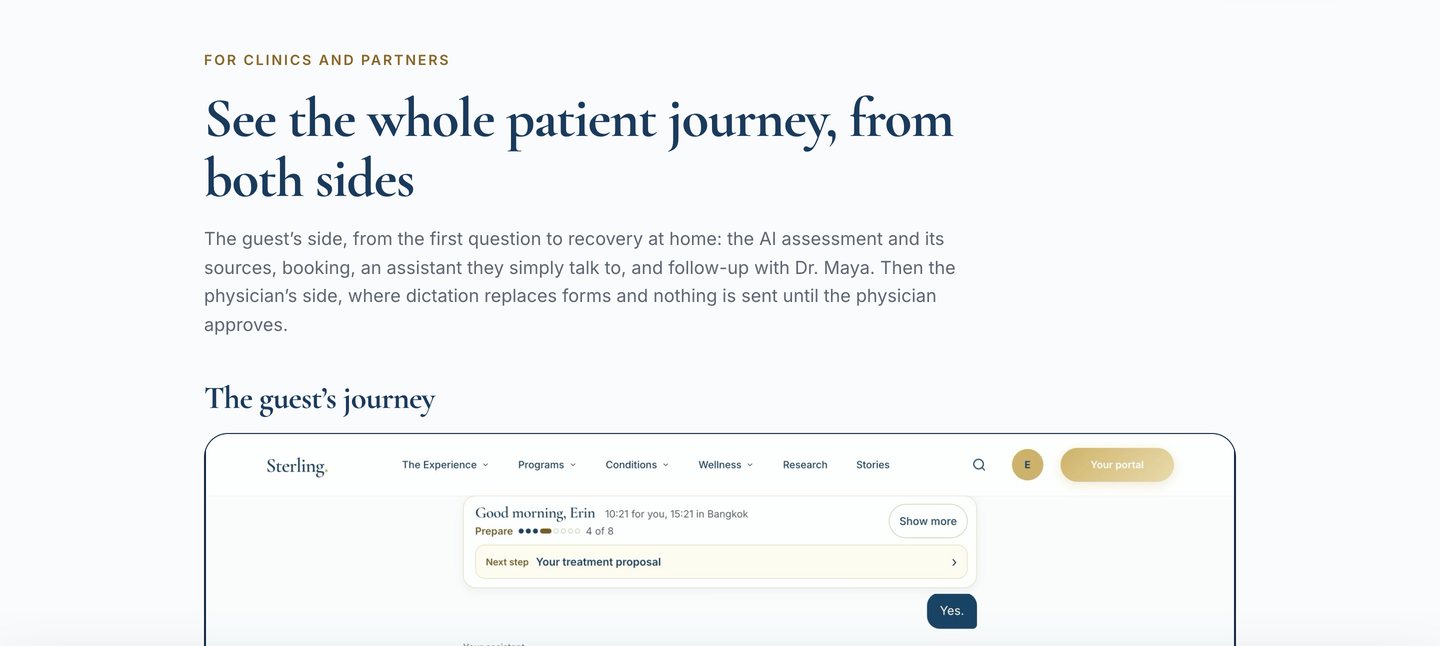
The health platform's demo page, showing the guest's journeySee the live demo →
268k
lines of application code
790+
research papers indexed for the content pipeline
776
commits in its repository since February 2026

07Terms

What stays yours

  • The code

    It lives in your repository and accounts from day one.

  • The knowledge

    Documentation and a decision log come with every delivery.

  • The capability

    Your developers learn to run the method themselves.

  • Your data

    Agents never receive production data. Risky changes need a person's approval.

  • The price

    Fixed and agreed before work starts.

08 Place

Tallinn, Helsinki, Stockholm

Sterlon is an Estonian company. We work from Tallinn and meet clients in person in Tallinn, Helsinki and Stockholm. The map is drawn from real survey data of the land and the seabed. Scroll to lower the sea.

Fig. 3
Three cities
Sea level
0 m
Land routes
at −61 and −70 m
Position
59°48′N 24°51′E
Depth
move over the map
Scroll
routes open at −61 and −70 m

Contours every 10 m at sea, 20 m on land. Land routes are measured inside this chart’s frame.
Straight lines are great circles.
Data: EMODnet Digital Bathymetry (DTM 2024)DTM 2024, CC BY 4.0.

09Contact

Start with 20 minutes

Tell us what you are building, where your team is stuck, or what your production keeps telling you. You leave the call with a clear next step.

hello@sterlon.eu
Book a 20-minute call